• Journal
    • Journal Issues
      • Current Issue – Issue #14
      • Issue #13
      • Issue #12
      • Archive
    • About the Journal
      • Aims and Scope
      • Author Guidelines
      • People
      • Ethics
    • Journal Search
      • Search all Journal Articles
  • Projects
    • Research Projects
      • Stedelijk Studies Masters
      • Mortality as Matter
      • Here for Now, Then and There
      • Sketches For The Future
      • Lines of Sight
      • Staff Shares
      • Rakurs
    • Fellowships
      • MMCA Studies x Stedelijk Studies Editorial Fellowship
      • Stedelijk x C& Editorial Fellowship
      • Editorial & Research Fellowships & Fellows
    • Exhibitions
      • MODERN — Van Gogh, Rietveld, Léger and others
      • Exhibition Felix de Rooy — Apocalypse
      • IT’S OUR F***ING BACKYARD
      • Surinamese School
    • Szine
      • Szine is an irregularly published zine that shares pressing research on the subjectivity of the museum in the cultural landscape
    • All projects
      • Ranging from brisk exhibitions to long-term research initiatives, encompassing Szine and Stedelijk Museum Fellowships
  • Research Logs
  • Essays
  • Conversations
  • About
    • About Stedelijk Studies
    • Collaborations
    • People
    • Contact
  • Search
  • Menu Menu
  • Link to Instagram Link to Instagram Link to Instagram
Meeting the Collection
Follow a manual added link
Search Search

Exhibition Research: Let Textiles Talk

Meeting the Collection

by Amanda Pinatih

My adventure at the Stedelijk Museum

Started on February 3, 2020: my first day as a design curator at the Stedelijk Museum after years of working as a freelance curator. I had made exhibitions in lots of different places, from a parking lot in Eindhoven to a traditional Japanese house on the small island of Dejima or a mobile museum in the homegrown neighbourhood of Dharavi. This February, I travelled to Marrakech for two weeks to make an exhibition for the project ONE SQUARE METER BERBER in Palais Bahia, a project I committed to before starting at the Stedelijk. When I came back, I greatly looked forward to working at the museum, in an office with lots of colleagues, gaining new experiences. But then Covid-19 hit the Netherlands, and after only a week of working in the office, we were all sent home…

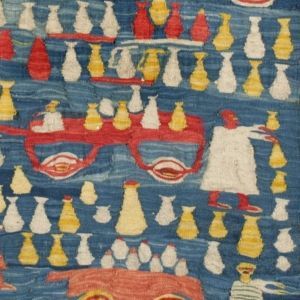
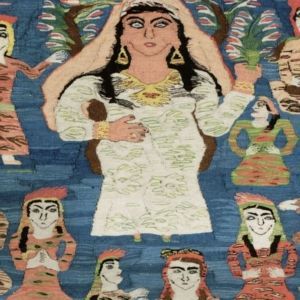
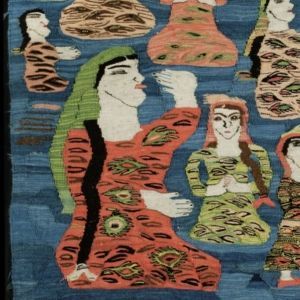
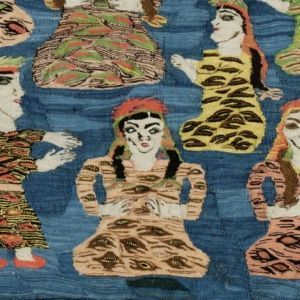
So how, as a newly appointed curator, do you get to know a museum collection from home? Thankfully, the online database encloses the entire museum collection: over 100,000 objects of which more than 50,000 of them belong to the design collection, in my and my colleagues care. So, with a cup of strong coffee and a fresh pair of eyes, on morning I started to look into this design collection. While scrolling through the numerous objects, six works caught my eye. Their tactile presence stuck out, and made them so distinct from other works in the collection: even digitally, you can almost feel their materiality when looking at the photographs. Although there is only a small black and white image per tapestry available in the database, the tapestries have quite a presence. Who made these textiles, and why are they in the Stedelijk’s collection? Are among the questions that immediately sprung to mind.

After some googling, I discovered that the tapestries were made by children at the Ramses Wissa Wassef Art Center. In 1951, Egyptian architect and educator Ramses Wissa Wassef embarked on an experiment in creativity that would be widely praised by prominent figures in the art world at the time, including then Stedelijk director Willem Sandberg, artist Etel Adnan and philosopher Jean Paul Sartre. Wassef wanted to prove that creativity is innate; that anyone can make art. He was disheartened by the general decline of creativity in 20th-century urban culture and found routine education stifling. So, he founded the Ramses Wissa Wassef Art Center and chose “uninhibited” young children who were isolated from many aspects of what he saw as “modern civilization” and taught them to weave as a form of creative expression. The Center still exists, and the tapestries have been internationally recognized since the late 1950s.

Willem Sandberg shared Wassef’s fascination with what he saw as the free expression of children and bought six tapestries from the exhibition Jong Egypte Weeft in the Fodor Museum in 1961-62, which he organised and designed the catalogue for. They have been in our collection ever since, not seeing much daylight as they have only been showed a couple of times after coming back from their tour to three museums in Norway in 1962.

This is Entry 1 of the Research Log that follows the development of the exhibition Let Textiles Talk, on view at the Stedelijk Museum from November 13, 2021.

Screenshot of Adlib Stedelijk Museum Amsterdam collection, made by Amanda Pinatih on 27 May 2021

Screenshot of Adlib Stedelijk Museum Amsterdam collection, made by Amanda Pinatih on 27 May 2021
This article is tagged with:
collection practices (23)design (30)material culture (26)textile design (9)the netherlands (94)

Sources:

https://garlandmag.com/article/wissa-wassef/
http://www.marlamallett.com/
https://web.archive.org/
https://www.resurgence.org/

More about Let Textiles Talk

Made in Harrania?
February 18, 2022/by Stedelijk Studies

Made in Harrania?

by Amanda Pinatih
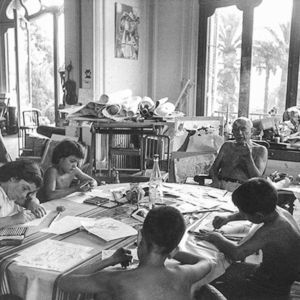
Pablo Picasso giving a drawing lesson to his children Paloma and Claude, and two friends. Photograph by Rene Burri / Magnum.Rene Burri / Magnum.
January 7, 2022/by Stedelijk

Picasso and the Art of Children

by Amélie Martelle​
How Textiles Talk and What They Have to Say. A Curatorial Introduction to the Exhibition Let Textiles Talk by Amanda Pinatih.
December 16, 2021/by Stedelijk

How Textiles Talk and What They Have to Say

Essay by Amanda Pinatih
An interview with Ali Selim
September 14, 2021/by Stedelijk Studies

An interview with Ali Selim

Log #6 by Amélie Martelle​
Visitors of the Wissa Wassef Centre
September 1, 2021/by Stedelijk

Visitors of the Wissa Wassef Centre

Log #5 by Amélie Martelle​
Diving into the Stadsarchiefs Amsterdam
August 15, 2021/by Stedelijk

Diving into the Stadsarchief Amsterdam

Log #4 by Amélie Martelle​
Serendipity
August 1, 2021/by Stedelijk

Serendipity

Log #3 by Amanda Pinatih
Checking the tapestries in the depot
July 19, 2021/by Stedelijk

The tapestries IRL

Log #2 by Amanda Pinatih
July 5, 2021/by Stedelijk

Meeting the Collection

Log #1 by Amanda Pinatih

Yayoi Kusama

YAYOI KUSAMA
PRE-SALE NOW LIVE
Exhibition — Sep 11, 2026 till Jan 17, 2027

Newsletter

Subscribe to Stedelijk Museum’s Academic Newsletter.

Share this page

  • Facebook Facebook Share on Facebook
  • Whatsapp Whatsapp Share on WhatsApp
  • Pinterest Pinterest Share on Pinterest
  • Linkedin Linkedin Share on LinkedIn

Stedelijk Studies on Instagram

Connect to Stedelijk Studies on Instagram

Subscribe to the Stedelijk Museum Academic Newsletter

Get the latest research, insights, and updates from Stedelijk Studies. Subscribe to the Stedelijk Museum’s Academic Newsletter.

© 2026 Stedelijk Studies.
  • Link to Instagram Link to Instagram Link to Instagram
  • Disclaimer
  • Colophon
  • Contact
  • Cookie Policy
  • Privacy Statement
Scroll to top Scroll to top Scroll to top
Stedelijk Studies
Manage Consent
To provide the best experiences, we use technologies like cookies to store and/or access device information. Consenting to these technologies will allow us to process data such as browsing behavior or unique IDs on this site. Not consenting or withdrawing consent, may adversely affect certain features and functions.
Functional Always active
The technical storage or access is strictly necessary for the legitimate purpose of enabling the use of a specific service explicitly requested by the subscriber or user, or for the sole purpose of carrying out the transmission of a communication over an electronic communications network.
Preferences
The technical storage or access is necessary for the legitimate purpose of storing preferences that are not requested by the subscriber or user.
Statistics
The technical storage or access that is used exclusively for statistical purposes. The technical storage or access that is used exclusively for anonymous statistical purposes. Without a subpoena, voluntary compliance on the part of your Internet Service Provider, or additional records from a third party, information stored or retrieved for this purpose alone cannot usually be used to identify you.
Marketing
The technical storage or access is required to create user profiles to send advertising, or to track the user on a website or across several websites for similar marketing purposes.
  • Manage options
  • Manage services
  • Manage {vendor_count} vendors
  • Read more about these purposes
View preferences
  • {title}
  • {title}
  • {title}